VIRTUAL REALITY FOR
VESTIBULAR REHABILITATION
Thinking about everyone in the world who suffers from balance disorders.
Learn how to apply it in just 15 minutes!

Meet with our product specialist and discover PhysioSensing Vertigo - a force platform with virtual reality designed to promote safe, objective, and engaging vestibular compensation.
PhysioSensing Vertigo
a clinical platform for balance training using virtual reality

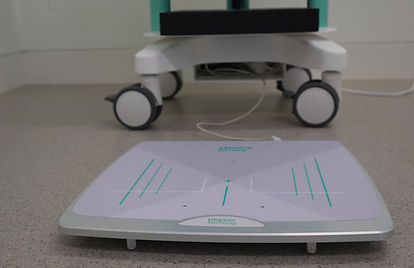
Developed for audiologists and otoneurologists, PhysioSensing Vertigo combines a high-precision force plaftorm with immersive VR scenarios for assessing and training patients with vestibular dysfunctions.
With it, you can:
✅ Assess postural stability with objective metrics and automatic reports.
✅ Implement exercises based on adaptation, habituation and substitution.
✅ Use immersive visual and auditory environments that simulate real life.
✅ Monitor patient progress quantitatively in real time.


+8 Balance
Assessment
Protocols
-
mCTSIB - Modified Clinical Test of Sensory Interaction on Balance
-
Romberg Test
-
Body Sway (posturography)
-
LOS - Limits of Stability
-
Fall Risk
-
Rhythmic Weight Shift
-
Unilateral Stance
-
Balance Error Scoring System


+6 Exercises
Categories
-
Balance and Stability
-
Figure and Paths
-
Random Points
-
Visual Stimulus
-
Protocol Training
- Load Charts

Libra VR Clinic
Virtual Reality
-
Smooth Pursuit
-
Saccadic
-
Optokinetic Nystagmus
-
VOR (Vestibulo Ocular Reflex)
-
VOR suppression
-
Vergence
-
Fixation
-
Seek and Find games
-
Visual Effects: Tunnel (Visual Parallax), Supermarket, Indoor and outdoor environments, Fantasy City, Universe/space, Car


From diagnosis
to sensory training:
a practical application
With PhysioSensing Vertigo, you can:
👉 Create challenging environments for gradual
motion exposure.
👉 Perform eye-head coordination exercises to compensate VOR deficits.
👉 Work on balance across different surfaces
and visual stimuli.
👉 Reinforce postural control using real-time
visual feedback.
This solution is for you if...
✅ You're an audiologist, otoneurologist,
or vestibular physiotherapist.
✅ You want to modernize your clinic with
evidence-based tools.
✅ You're looking for ways to engage
low-adherence patients.
✅ You treat patients with BPPV, vestibular hypofunction, central vertigo, or balance issues.
Evidence-based.
Clinically proven.
Studies show that virtual reality significantly improves dizziness scores (DHI), enhances postural control, and increases patient engagement during vestibular rehabilitation.


Benefits
✅ Reduced dizziness and instability symptoms.
✅ Increased adherence through gamified, engaging formats.
✅ Measurable progress with automatic reports.
✅ Easy to integrate into your clinical routine.